
The Future of AI Coaching Will Be Decided by Governance, Not Technology
Posted by Alexandra Lamb
When new technologies emerge, our instinct is often to focus on what they can do. We marvel at their capabilities, speculate about their future potential, and compare their performance against the systems they may eventually replace. Artificial intelligence has followed precisely this trajectory. Within the coaching profession, much of the discussion has centred on the quality of AI-generated questions, the sophistication of large language models, and the extent to which AI can emulate the behaviours of a professional coach.
After reading Coaching in the Age of AI: Perspectives on Opportunities, Challenges and Future Directions, however, I have become convinced that these are no longer the questions that matter most.
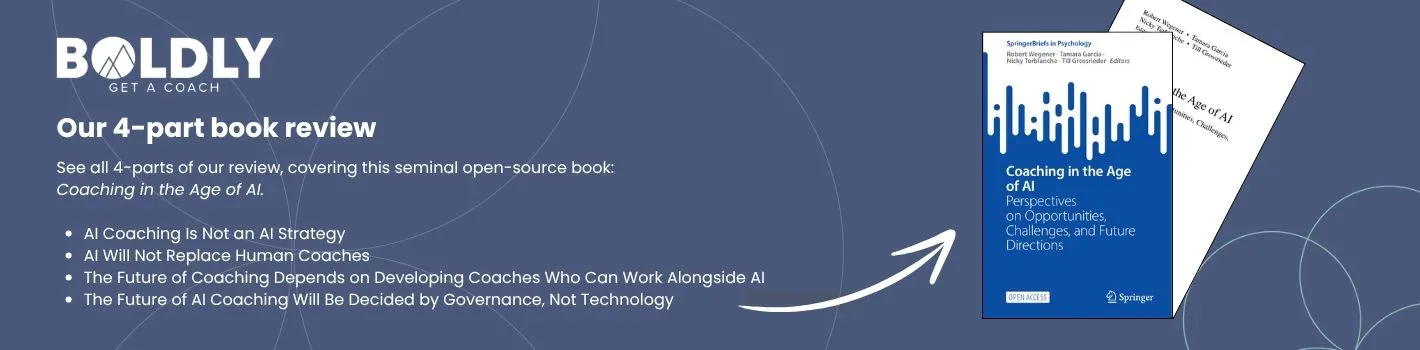
The editors—Robert Wegener, Tamara Garcia, Nicky Terblanche and Till Grossrieder—close the book with a collection of chapters that move beyond technology and into the broader societal, professional and philosophical implications of AI coaching. Rather than asking what AI is capable of today, Part V asks what kind of profession—and what kind of organisations—we wish to create as AI becomes embedded within leadership development and coaching practice. These closing reflections bring together many of the themes introduced throughout the book, while challenging readers to think beyond implementation towards stewardship, governance and long-term responsibility. Like the rest of the volume, Part V is published as Open Access, reflecting the editors' belief that the future direction of AI coaching should be informed by collective learning rather than restricted access to knowledge.
This final article concludes the series by arguing that the future of AI coaching will not ultimately be determined by technological innovation. It will be determined by the quality of the governance systems, professional standards and organisational decisions that surround it.
The Technology Is Advancing Faster Than the Institutions Around It
One of the strongest impressions left by the concluding chapters is the growing gap between technological capability and institutional readiness.
Artificial intelligence is evolving at extraordinary speed. New models are released within months rather than years. Capabilities that appeared experimental only a short time ago are now becoming commercially available. Organisations are understandably eager to explore how these developments might improve leadership development, increase access to coaching and reduce the cost of personalised support.
Yet institutions evolve more slowly.
Professional bodies develop standards over years. Organisations establish governance through consultation and policy development. Regulatory frameworks inevitably lag behind technological innovation. Even organisational cultures require time to adapt to fundamentally new ways of working.
Part V recognises that AI coaching now exists within this tension. The technology is becoming increasingly capable, while many of the professional, ethical and organisational structures required to support its responsible use remain under development.
This is not presented as a reason to delay innovation. Rather, it is presented as a reason to innovate responsibly.
From Ethical Principles to Organisational Practice
Throughout the book, ethics is consistently discussed as more than a theoretical concern. By the time readers reach Part V, it becomes apparent that ethical AI coaching cannot rely solely on individual practitioners making good decisions. Ethical practice must become embedded within organisational systems.
This represents an important shift.
Many organisations continue to think about AI governance primarily through the lens of legal compliance or cybersecurity. While both are essential, the scholarship presented throughout the book suggests that governance must also encompass professional standards, coaching ethics, transparency, accountability and human oversight.
Questions such as who owns coaching data, how AI-generated insights are used, how confidentiality is protected and when human intervention becomes necessary cannot be delegated entirely to software vendors. These are governance decisions that organisations themselves must make.
In this respect, AI coaching begins to resemble other significant organisational capabilities such as leadership development, performance management or succession planning. Technology enables these systems, but governance determines whether they generate trust.
The Future of Coaching Remains Deeply Human
One of the more thoughtful themes running through Part V is that the rise of AI should not lead the coaching profession to abandon the principles upon which it has been built.
Artificial intelligence undoubtedly changes the tools available to coaches. It changes the accessibility of coaching. It changes the speed with which feedback can be generated and developmental support delivered.
It does not, however, eliminate the need for human judgement.
Indeed, the opposite may prove true.
As coaching becomes increasingly supported by intelligent technologies, the distinctly human dimensions of the profession become more valuable rather than less. Ethical discernment, contextual interpretation, moral reasoning, cultural sensitivity and the ability to navigate organisational complexity remain characteristics that cannot simply be reduced to computational capability.
This observation is particularly relevant for executive coaching. Senior leaders rarely face problems that can be solved through information alone. They navigate ambiguity, competing stakeholder interests, organisational politics and value-based decisions. AI can undoubtedly contribute to those conversations, but the responsibility for interpretation continues to rest with people.
The future described in Part V is therefore not one in which humans become less important. It is one in which human responsibility becomes more significant.

The Profession Is Entering a New Phase of Maturity
Another important contribution of the closing chapters is their recognition that AI coaching is no longer an experimental curiosity.
The field is beginning to develop its own body of research, ethical frameworks, implementation experiences and professional standards. International coaching bodies have begun publishing guidance. Universities are incorporating AI into coaching education. Organisations are moving from pilot programmes towards enterprise implementation.
These developments suggest that AI coaching is entering a new phase of maturity. With maturity comes responsibility.
Future progress will depend less upon demonstrating that AI can coach and more upon establishing shared standards regarding what constitutes good AI coaching practice. Evidence, transparency and professional accountability therefore become increasingly important.
This is an encouraging direction for the profession. Rather than allowing commercial innovation alone to shape the future of coaching, researchers, educators, professional associations and organisations are beginning to contribute collectively to its development.
Implications for Coaching for Organisational Transformation
Reflecting across all four parts of the book, one conclusion becomes increasingly difficult to ignore.
The conversation has evolved beyond AI coaching itself.
Part II examined the psychology and ethics of AI coaching.
Part III explored how AI can augment coaching practice.
Part IV considered how coaches themselves must evolve.
Part V in review here brings these themes together by asking what kind of organisational systems are required to support this new reality.
This is precisely why I believe organisations need to begin thinking in terms of Coaching for Organisational Transformation.
The implementation of AI coaching is not a technology project.
Nor is it simply a learning and development initiative.
It is an organisational transformation programme that spans leadership strategy, organisational development, governance, data management, coach capability, culture and change management.
When viewed from this perspective, AI coaching becomes one component within a much broader coaching ecosystem. Human coaches remain essential. Leadership programmes continue to matter. Manager capability becomes increasingly important. Governance provides legitimacy. Ethics sustains trust. Technology enables scale.
The transformation occurs not because one of these elements exists in isolation, but because they function together as an integrated organisational system.
What This Means for Enterprise Organisations
For organisations moving from experimentation towards enterprise implementation, Part V offers several enduring lessons.
First, governance should be treated as a strategic capability rather than a compliance exercise. Organisations require clear decision-making frameworks regarding ethics, privacy, accountability, data ownership and human oversight before AI coaching becomes embedded at scale.
Second, AI coaching should become part of a broader organisational capability strategy. Leadership development, organisational development, coaching, talent management and change initiatives should increasingly be designed as interconnected systems rather than independent programmes.
Third, organisations should establish multidisciplinary governance structures. Decisions regarding AI coaching should not sit solely within IT or learning and development functions. Human resources, organisational development, legal, information security, executive leadership and coaching professionals all have important contributions to make.
Finally, organisations should evaluate success through organisational outcomes rather than technological adoption. The most meaningful measures of AI coaching will remain improvements in leadership capability, decision quality, organisational adaptability, employee growth and cultural transformation.

A Final Reflection
Across this four-part series, one theme has consistently emerged from Coaching in the Age of AI.
Artificial intelligence is undoubtedly transforming coaching. Yet the most profound transformation may not occur within coaching conversations themselves.
It may occur within organisations that learn to redesign how leadership capability is developed, supported and sustained.
Technology will continue to improve. Large language models will become more sophisticated. AI coaching platforms will become more capable. These developments are almost inevitable.
The more important question is whether our organisations, our professional standards and our leadership practices will evolve with equal purpose.
The organisations that succeed in the coming decade will not necessarily be those that adopt AI coaching first. They will be those that implement it most thoughtfully—grounding innovation in evidence, embedding ethics within governance, investing in human capability and recognising that technology alone does not transform organisations. People do.
AI may become one of the most powerful enablers of leadership development we have ever seen. But its long-term contribution will depend on our willingness to design coaching ecosystems that combine technological innovation with human wisdom.
That, ultimately, is the promise of Coaching for Organisational Transformation.
Further Reading
International Coaching Federation – Artificial Intelligence Coaching Framework and Standards
European Mentoring and Coaching Council (EMCC Global)
UNESCO Recommendation on the Ethics of Artificial Intelligence
Closing Thoughts
This series has explored AI coaching through four complementary lenses: AI as a coaching partner, AI as an enhancer of coaching practice, AI as a catalyst for the evolution of the coaching profession, and finally AI as a driver of broader organisational transformation. Taken together, the book makes a compelling case that the future of coaching will not be determined by technology alone. It will be shaped by the choices organisations, professional bodies, educators and coaches make today about how AI is governed, integrated and applied in service of human development.
AUTHOR: Alexandra Lamb
Alexandra is an accomplished executive coach and organisational development practitioner, with experience across APAC, North America and MENA.
With 20+ years in professional practice, conglomerates and startup, she has collaborated with rapid-growth companies and industry innovators to develop leaders and high-performance teams. She is particularly experienced in talent strategy as a driver for startup growth.
Drawing from her experience in the fields of talent management, psychology, coaching, product development and human centred design, Alex prides herself on using commercial acumen and evidence-based coaching techniques to design talent solutions with true impact.