
The Future of Coaching Depends on Developing Coaches Who Can Work Alongside AI
Posted by Alexandra Lamb
One of the most striking features of the current conversation surrounding artificial intelligence and coaching is how frequently it focuses on the technology itself. Organisations are evaluating AI coaching platforms, researchers are exploring the capabilities of large language models, and coaches are understandably asking what this means for the future of their profession. Yet relatively little attention has been given to a more fundamental question: how must the coaching profession itself evolve in response to artificial intelligence?
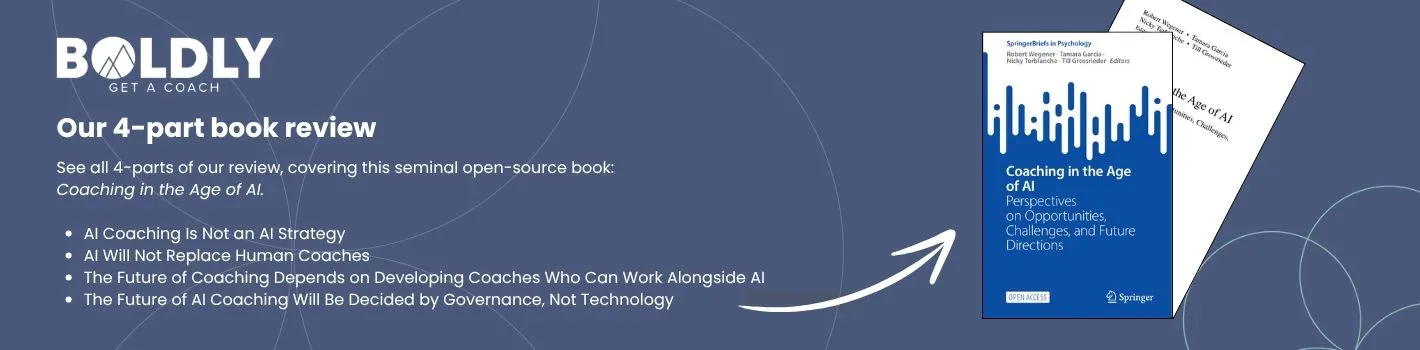
This question sits at the centre of Part IV of Coaching in the Age of AI: Perspectives on Opportunities, Challenges and Future Directions, edited by *Robert Wegener, Tamara Garcia, Nicky Terblanche and Till Grossrieder. Whereas the previous sections of the book examine AI as a coaching partner and as a tool to enhance coaching practice, Part IV turns its attention towards the profession itself. Through contributions examining coach education, supervision, reflective practice and professional development, the authors argue that AI is not simply changing how coaching is delivered—it is beginning to change what it means to be a coach.
This may ultimately prove to be one of the most important sections of the book.
Across every profession affected by artificial intelligence, there is growing recognition that technology rarely eliminates expertise. Instead, it reshapes it. The same appears to be true for coaching. The central question is no longer whether coaches will continue to play an important role in organisational development. Rather, it is how coaches will develop the capabilities required to work effectively within increasingly AI-enabled coaching ecosystems.
As with the rest of this important volume, Springer has published the book as an Open Access resource, recognising that the future of coaching should be informed by evidence that is accessible to practitioners, educators and organisations alike.
Professional Practice Is Being Redefined
Throughout the history of executive coaching, the profession has evolved alongside developments in psychology, neuroscience, leadership theory and organisational behaviour. Each shift has expanded both the knowledge base and the expectations placed upon professional coaches.
Artificial intelligence represents another such shift, but one that differs in an important respect. Previous developments primarily expanded what coaches needed to know. AI is beginning to change how coaches work.
Across the contributions in Part IV, the authors argue that coaching should not view AI solely as a new technology to master, but as a catalyst for professional evolution. Coaches are increasingly being asked to integrate AI into their own reflective practice, their supervision, their preparation for coaching engagements and their ongoing professional learning. This represents a significant expansion of the coaching toolkit, but it also raises important questions about professional identity, ethical responsibility and capability development.
The implication is clear. Future coaching competence will not be defined only by mastery of coaching methodologies or psychological theory. It will increasingly include the ability to work critically and responsibly with intelligent technologies.
AI as a Tool for Reflective Practice
One of the most compelling ideas emerging from Part IV is that AI may have its greatest impact not during coaching conversations, but between them.
Reflection has always been central to coach development. Supervision, peer learning, reflective journaling and deliberate practice have long been recognised as essential mechanisms through which coaches improve their effectiveness. AI introduces new possibilities for enriching these practices.
Intelligent systems are now capable of assisting coaches to analyse coaching transcripts, identify recurring questioning patterns, highlight conversational blind spots and prompt deeper self-reflection. Rather than replacing supervision, AI has the potential to make reflective practice more frequent and more accessible.
This distinction is important because professional development has traditionally depended upon relatively infrequent opportunities for structured feedback. AI offers the possibility of creating continuous learning loops in which coaches receive ongoing insights into their own practice while remaining accountable to human supervision and professional standards.
The contributors are careful not to suggest that AI becomes the supervisor. Rather, AI becomes an additional source of reflection that can support the coach's own learning process. Professional judgement, ethical interpretation and developmental conversations remain fundamentally human activities.
Supervision Becomes More Important, Not Less
One of the more interesting paradoxes emerging from Part IV is that the growth of AI coaching may actually increase the importance of supervision.
As AI becomes embedded within coaching practice, coaches will increasingly encounter ethical dilemmas that extend beyond traditional coaching questions. How should AI-generated insights be interpreted? When should coaches rely on AI summaries or recommendations? How should confidentiality be maintained when intelligent systems process coaching conversations? How should coaches recognise and mitigate algorithmic bias?
These questions cannot be answered by technology alone.
Instead, they require mature professional judgement developed through supervision, ethical reflection and continuous dialogue with experienced practitioners.
In this sense, AI elevates rather than diminishes the value of supervision. The complexity of coaching practice increases as coaches become responsible not only for managing human relationships but also for understanding the implications of intelligent technologies within those relationships.
For professional bodies, coach educators and organisations employing coaches, this represents an important shift. Supervision may become one of the primary mechanisms through which responsible AI coaching practice is maintained.
Coach Education Must Evolve
Perhaps the strongest message throughout Part IV is that coach education itself requires reconsideration.
Historically, coaching education has focused on psychological theory, coaching models, communication skills, ethics and supervised practice. These foundations remain essential. However, they are no longer sufficient on their own.
Future coach education is likely to require greater emphasis on digital literacy, critical thinking, data governance, AI ethics, prompt design, human-AI collaboration and systems thinking. Coaches will need to understand not only how AI operates, but also where its limitations lie and when human intervention becomes essential.
This does not imply that coaches should become technologists.
Rather, it recognises that responsible coaching practice increasingly depends upon understanding the technologies shaping contemporary coaching environments.
The authors therefore encourage educators to view AI not simply as another subject within the curriculum, but as a force reshaping professional competence itself.
The Rise of the AI-Augmented Coach
One concept that consistently emerged for me while reading Part IV was the idea of the AI-augmented coach.
Much of the public discussion continues to assume a binary choice between human coaches and AI coaches. The scholarship presented throughout this section suggests a far more interesting possibility.
The most effective coaches of the future may be those who use AI to strengthen their own capability.
Imagine coaches who routinely use AI to prepare for sessions by synthesising previous conversations, identifying developmental themes and suggesting reflective questions.
Imagine coaches who use AI after sessions to review their own questioning patterns, identify assumptions or explore alternative approaches.
Imagine supervision that combines human wisdom with AI-supported analysis to accelerate professional learning.
None of these scenarios diminish the importance of the coach.
Instead, they allow coaches to devote more of their attention to the distinctly human aspects of their practice: presence, empathy, ethical judgement, contextual understanding and developmental partnership.
The coach becomes more capable precisely because technology assumes responsibility for those tasks that do not require uniquely human expertise.

Implications for Coaching for Organisational Transformation
For organisations, Part IV shifts the conversation in an important direction.
Much of the current enterprise discussion focuses on preparing employees to work alongside AI. Considerably less attention has been paid to preparing coaches themselves.
Yet organisations cannot build sophisticated coaching cultures without equally sophisticated coaching capability.
If AI coaching is to become part of enterprise leadership development, organisations must invest not only in AI platforms but also in the ongoing development of their internal coaches, external coaching partners and people leaders.
This is one of the reasons I advocate for Coaching for Organisational Transformation.
Organisational transformation is not achieved by introducing another digital tool. It is achieved by strengthening the capability of the entire coaching system.
That system includes professional coaches.
It includes coaching supervisors.
It includes leadership facilitators.
It includes managers expected to coach their teams.
It includes governance structures.
It includes ethical oversight.
It includes AI.
Treating AI coaching as a standalone technology initiative risks overlooking the capability development required across the wider organisational ecosystem.
What This Means for Enterprise Organisations
The scholarship presented throughout Part IV suggests several practical implications for organisations seeking to implement AI coaching responsibly.
First, AI capability should become part of coach capability frameworks. Whether organisations employ internal coaches or engage external coaching providers, expectations regarding AI literacy, ethical practice and responsible technology use should increasingly form part of professional standards.
Second, organisations should invest in supervision as implementation scales. AI introduces new forms of complexity that require structured reflection and ongoing professional dialogue. Supervision therefore becomes a governance mechanism as much as a developmental one.
Third, coach development programmes should incorporate practical experience working alongside AI rather than treating AI as a theoretical topic. Coaches require opportunities to experiment, reflect and develop confidence within supported learning environments.
Finally, organisations should recognise that the quality of AI coaching implementation will ultimately depend less on the sophistication of the technology than on the capability of the people responsible for integrating it into organisational practice.

Looking Ahead
Part IV of Coaching in the Age of AI reminds us that every technological transformation is also a professional transformation.
Artificial intelligence is undoubtedly changing coaching practice, but its most enduring impact may lie in the way it reshapes the capabilities expected of professional coaches. Reflection, supervision, ethical reasoning and continuous learning become even more important as intelligent technologies become increasingly integrated into coaching.
For organisations, this insight is particularly valuable. AI coaching cannot simply be implemented through procurement. It requires investment in professional capability, governance and organisational learning.
Ultimately, the organisations that realise the greatest value from AI coaching will not be those with the most advanced algorithms. They will be those that develop coaches capable of working thoughtfully, ethically and confidently alongside AI while remaining deeply grounded in the human principles that have always defined excellent coaching.
That is another essential building block in creating Coaching for Organisational Transformation—a future in which AI enhances not only coaching conversations, but the capability of the coaching profession itself.
Series conclusion: Blog 4 will explore Part V of the book, examining the broader societal, philosophical and strategic questions raised by AI coaching and what they mean for the future of organisations, leadership and the coaching profession HERE.
Further Reading
International Coaching Federation – Artificial Intelligence Coaching Framework and Standards
European Mentoring and Coaching Council (EMCC Global)
AUTHOR: Alexandra Lamb
Alexandra is an accomplished executive coach and organisational development practitioner, with experience across APAC, North America and MENA.
With 20+ years in professional practice, conglomerates and startup, she has collaborated with rapid-growth companies and industry innovators to develop leaders and high-performance teams. She is particularly experienced in talent strategy as a driver for startup growth.
Drawing from her experience in the fields of talent management, psychology, coaching, product development and human centred design, Alex prides herself on using commercial acumen and evidence-based coaching techniques to design talent solutions with true impact.