
AI Coaching Is Not an AI Strategy: What Coaching in the Age of AI Reveals About the Future of Enterprise Coaching
Posted by Alexandra Lamb
Artificial intelligence has rapidly become one of the defining topics in leadership development and executive coaching. Within only a few years, organisations have moved from asking whether AI could ever support coaching conversations to actively evaluating AI coaching platforms as part of their leadership and talent strategies. Yet while the technology has advanced at extraordinary speed, the evidence base guiding its implementation has struggled to keep pace. For many organisations, the challenge is no longer access to AI coaching technology; it is understanding how to implement it responsibly, ethically and effectively.
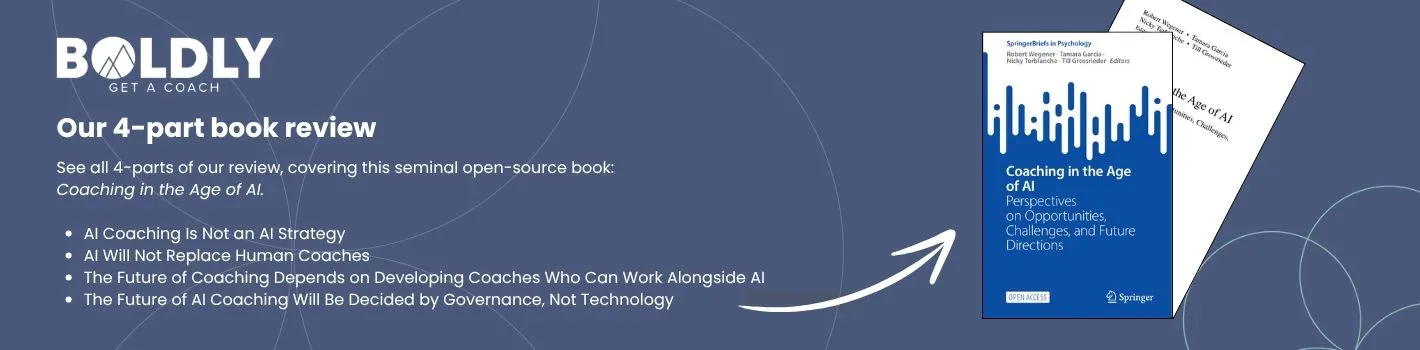
This challenge sits at the heart of Coaching in the Age of AI: Perspectives on Opportunities, Challenges and Future Directions, edited by Robert Wegener, Tamara Garcia, Nicky Terblanche and Till Grossrieder. The book brings together leading researchers and practitioners to examine AI coaching from multiple disciplinary perspectives, including coaching psychology, ethics, behavioural science and artificial intelligence. Importantly, the editors and Springer have chosen to publish the volume as Open Access, recognising that the rapid evolution of AI coaching demands broad access to evidence rather than limiting it to academic institutions. As organisations around the world begin experimenting with AI coaching, the profession benefits when research is openly available, debated and translated into practice.
This article is the first in a four-part series reflecting on the major themes of the book. Rather than reviewing individual chapters, the series aims to synthesise the central arguments emerging from each section and explore their implications for organisations. Throughout these articles, I will argue that the conversation must now evolve beyond AI coaching itself towards what I describe as Coaching for Organisational Transformation—an approach that considers AI coaching as one component within a broader organisational system of leadership development, governance, culture and change.
The Question Has Changed
Much of the public conversation surrounding AI coaching has been framed around a deceptively simple question: Can artificial intelligence coach? It is an understandable place to begin. Coaching has traditionally been understood as a deeply human process built upon trust, empathy, reflective dialogue and the quality of the relationship between coach and client. Asking whether a machine can replicate those qualities appears, at first glance, to be the central issue.
Part II of Coaching in the Age of AI suggests that this framing is now too narrow.
Across contributions from Rebecca Rutschmann, Vanessa Mai, Anja Richert, Christina Mühlberger, Eva Jonas, Jan Juchli, Marcel Schär-Gmelch and Nicky Terblanche, a more sophisticated picture begins to emerge. Rather than debating whether AI is capable of replacing human coaches, the authors collectively examine the psychological, ethical and practical conditions under which AI may become a legitimate coaching partner. Their work reflects a field that is maturing beyond technological curiosity towards rigorous inquiry into what constitutes effective coaching in an AI-enabled world.
One of the strongest themes running through this section is that AI coaching cannot be evaluated solely through the lens of technological capability. Advances in natural language processing may determine how convincingly an AI responds during a coaching conversation, but they tell us relatively little about whether those interactions produce meaningful developmental outcomes. Coaching has always been more than a sequence of well-structured questions. It is a developmental process shaped by psychological safety, ethical practice, context, motivation and the quality of the reflective experience. Evaluating AI coaching therefore requires a broader framework than simply assessing conversational fluency.
Reconsidering the Coaching Relationship
Perhaps the most significant contribution of Part II is its examination of the coaching relationship itself. Traditional coaching literature consistently identifies the working alliance between coach and client as one of the strongest predictors of coaching effectiveness. Trust, empathy, mutual understanding and psychological safety are widely recognised as central mechanisms through which coaching facilitates learning and behaviour change.
The emergence of AI coaching challenges some of these assumptions.
The contributors explore an emerging body of evidence suggesting that people may engage with AI coaching systems in ways that differ from, rather than simply replicate, human coaching relationships. Early studies indicate that users often experience AI as consistently available, patient and non-judgemental. In some contexts, participants report feeling unexpectedly comfortable disclosing personal concerns or exploring difficult issues with an AI system. This finding does not imply that artificial intelligence possesses empathy in the human sense, nor does it diminish the importance of skilled human coaches. Rather, it suggests that the psychological dynamics underpinning AI coaching may differ from those traditionally associated with human coaching relationships.
This distinction is particularly important for organisations. If AI coaching is evaluated only against the standards established for human coaching, its unique strengths may be overlooked. Conversely, if organisations assume that conversational sophistication alone is sufficient, they risk overestimating the capability of current systems. The emerging research instead encourages a more nuanced understanding: AI coaching may create value through different psychological mechanisms, and these mechanisms require further investigation before broad claims about effectiveness can be made.
Ethics as an Organisational Capability
If coaching relationships form one pillar of Part II, ethical implementation forms the second.
Rebecca Rutschmann's chapter provides a thoughtful examination of the ethical implications of AI coaching, arguing that established coaching ethics require reinterpretation in environments where conversations are mediated through intelligent systems. Issues such as confidentiality, informed consent, algorithmic transparency, accountability and bias become significantly more complex once coaching interactions involve large language models and data-driven platforms.
Importantly, the ethical discussion presented throughout Part II extends well beyond concerns about technology itself. Bias is not described merely as a characteristic of algorithms but as something that may emerge throughout the wider coaching ecosystem. Decisions about training data, prompt design, leadership frameworks, organisational values and implementation strategy all influence the behaviour of AI coaching systems. Ethical AI coaching therefore cannot be achieved solely through technical safeguards. It requires governance structures capable of overseeing how coaching is designed, deployed and evaluated within organisations.
This represents an important shift in thinking. Many organisations currently approach AI coaching through the lens of technology procurement, focusing on platform capabilities, functionality and user experience. The scholarship presented in Part II suggests that governance, ethics and organisational design should receive equal, if not greater, attention. AI coaching should not simply be purchased; it should be governed.

An Emerging Evidence Base
The contributors are also notable for their restraint. Despite the considerable enthusiasm surrounding AI coaching, Part II avoids making exaggerated claims about its effectiveness. Nicky Terblanche's review of the current evidence highlights both encouraging findings and important limitations. While AI coaching shows considerable promise across several domains, the empirical literature remains relatively young compared with decades of research supporting traditional coaching approaches. Longitudinal studies remain limited, comparative research is still developing, and many questions regarding sustained behavioural change have yet to be answered.
This balanced perspective is one of the book's greatest strengths. Rather than positioning AI coaching as either an inevitable replacement for human coaching or an overhyped technological distraction, the contributors advocate for evidence-informed experimentation. Organisations are encouraged to innovate, but they are equally encouraged to evaluate, measure and continuously learn from implementation.
For executive leaders, this is perhaps one of the most valuable messages in the book. AI coaching should not be adopted because it is novel, nor rejected because it is unfamiliar. It should be implemented with the same discipline that organisations apply to any significant organisational intervention: through careful design, evaluation and ongoing refinement.
From AI Coaching to Coaching for Organisational Transformation
While Part II provides valuable insights into the psychology and ethics of AI coaching, it also highlights what I believe is the next frontier for both research and practice.
Most discussions about AI coaching continue to focus on the interaction between one individual and one AI system. This perspective is entirely understandable given the relative novelty of the technology. However, organisations do not implement coaching in isolation. Coaching exists within leadership frameworks, talent strategies, organisational cultures, governance systems and broader transformation agendas.
For this reason, I believe the conversation must now expand beyond AI coaching towards Coaching for Organisational Transformation.
This perspective does not ask whether AI can coach. Instead, it asks how organisations can design integrated coaching ecosystems in which AI coaching, human coaching, leadership development, manager capability, organisational learning and behavioural data work together to support sustainable organisational change. The technology becomes one component within a much larger developmental architecture.
Such an approach also reframes the implementation challenge. Rather than beginning with platform selection, organisations begin by asking what organisational capabilities they are seeking to develop. AI coaching is then positioned alongside human coaching, leadership programmes, team coaching, communities of practice and organisational development initiatives as part of an integrated transformation strategy.

What This Means for Enterprise Organisations
For organisations currently evaluating AI coaching, Part II offers several practical lessons.
First, AI coaching should be implemented within a clearly defined organisational purpose. Whether the objective is strengthening leadership capability, increasing access to coaching, supporting organisational change or improving manager effectiveness will fundamentally influence how AI coaching should be designed.
Second, governance should precede scale. Ethical principles, data privacy, transparency, human oversight and quality assurance should be established before organisations seek widespread adoption. The absence of governance will ultimately undermine trust, regardless of how sophisticated the technology becomes.
Third, AI coaching should complement rather than compete with human coaching. The evidence reviewed throughout Part II suggests that the greatest opportunity lies not in replacing experienced coaches, but in extending coaching access, reinforcing learning between coaching sessions, supporting self-reflection and creating new developmental pathways that were previously impossible to deliver at scale.
Finally, organisations should evaluate AI coaching against organisational outcomes rather than technological performance. Success should be measured by improvements in leadership capability, behavioural change, organisational learning and transformation—not simply by conversation volume or user engagement.
Looking Ahead
Part II of Coaching in the Age of AI marks an important step in the evolution of AI coaching from technological innovation towards an evidence-informed field of professional practice. Its greatest contribution is not that it answers every question about AI coaching, but that it reframes the questions themselves. Rather than asking whether AI can imitate a coach, the contributors invite us to examine the psychological, ethical and organisational conditions under which AI coaching can create meaningful value.
For enterprise leaders, this shift in perspective could not be more timely. The organisations that derive the greatest benefit from AI coaching are unlikely to be those that simply deploy the most advanced technology. They will be those that understand AI coaching as part of a broader system of organisational capability, supported by thoughtful governance, evidence-informed practice and a clear vision for leadership development.
That is why I believe the future lies not simply in AI coaching, but in Coaching for Organisational Transformation. The competitive advantage will belong not to organisations with the most sophisticated AI platform, but to those capable of designing the most sophisticated coaching ecosystems.
Read Blog 2 in our 4-part series review of this open access book HERE.
Further Reading
ICF Artificial Intelligence Coaching Framework and Standards
UNESCO Recommendation on the Ethics of Artificial Intelligence
AUTHOR: Alexandra Lamb
Alexandra is an accomplished executive coach and organisational development practitioner, with experience across APAC, North America and MENA.
With 20+ years in professional practice, conglomerates and startup, she has collaborated with rapid-growth companies and industry innovators to develop leaders and high-performance teams. She is particularly experienced in talent strategy as a driver for startup growth.
Drawing from her experience in the fields of talent management, psychology, coaching, product development and human centred design, Alex prides herself on using commercial acumen and evidence-based coaching techniques to design talent solutions with true impact.