
AI Will Not Replace Human Coaches. It Will Redefine What Great Coaching Looks Like
Posted by Alexandra Lamb
As organisations continue to explore artificial intelligence as part of their leadership and talent strategies, much of the public discourse remains dominated by a familiar question: Will AI replace human coaches? It is an understandable concern, particularly given the rapid advances in generative AI and conversational technologies over the past two years. Yet it is also a question that risks obscuring a far more important conversation.
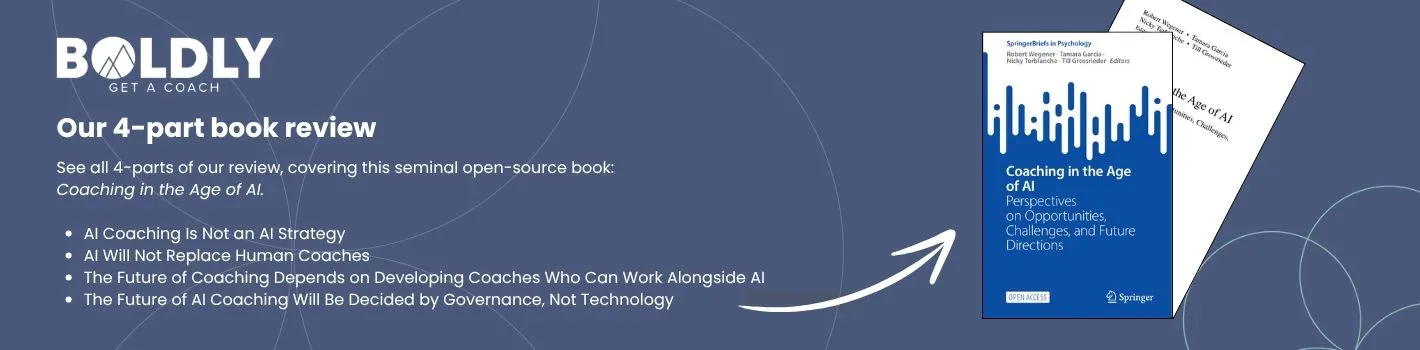
The real challenge facing organisations is not whether AI can replace a coach, but how AI can enhance the quality, accessibility and effectiveness of coaching within an enterprise. This shift in perspective lies at the heart of Part III of Coaching in the Age of AI: Perspectives on Opportunities, Challenges and Future Directions, edited by *Robert Wegener, Tamara Garcia, Nicky Terblanche and Till Grossrieder. Whereas Part II explored the emergence of AI as a coaching partner in its own right, Part III examines how artificial intelligence can augment human coaching practice. The distinction is significant. Rather than positioning AI as a substitute for professional coaches, the contributors investigate how intelligent technologies may strengthen coaching before, during and after coaching engagements, while simultaneously raising new questions about professional practice, capability and ethics. As with the rest of the volume, the editors have made the book freely available as an Open Access publication, recognising the importance of ensuring that evidence-based thinking is widely accessible as the profession evolves.
This second article in the series argues that Part III of this book marks an important transition in the AI coaching conversation. The discussion is no longer centred on whether AI can coach independently; instead, it considers how AI may reshape the practice of coaching itself. For organisations, this represents a profound shift. The future is unlikely to be characterised by a choice between AI and human coaching. Rather, it will be defined by organisations that learn to design integrated coaching ecosystems in which technology amplifies human capability while preserving the uniquely human dimensions of coaching that remain essential for leadership development and organisational change.
Moving Beyond the Replacement Narrative
One of the defining strengths of Part III is its refusal to frame AI as a competitive threat to coaches. Across the chapters, the contributing authors consistently challenge the assumption that technological progress necessarily implies professional displacement. Instead, they present AI as a collection of capabilities that can enhance multiple aspects of the coaching process, from preparation and reflection to insight generation, supervision and ongoing development.
This represents an important departure from much of the popular discussion surrounding AI. Public narratives often assume that professions will either be automated or preserved. The contributors to Part III suggest a far more nuanced future, in which coaching evolves through collaboration between human expertise and intelligent technologies. Such a perspective aligns with broader research across knowledge-intensive professions, where AI is increasingly understood not as a replacement for expert judgement but as a means of extending human capability.
For coaching, this distinction is particularly significant because coaching has never been defined solely by the conversation itself. A successful coaching engagement depends upon preparation, reflection, observation, feedback, accountability, continuous learning and sustained behaviour change. Many of these activities are well suited to intelligent technologies, while others continue to rely upon distinctly human capabilities such as ethical judgement, contextual interpretation and relational presence.
AI as a Cognitive Partner
Across Part III, AI increasingly emerges as what might be described as a cognitive partner for both coaches and coachees. Rather than replacing reflective thinking, AI has the potential to expand it.
For coaches, intelligent systems may assist in identifying themes across conversations, generating reflective questions, summarising coaching sessions, identifying behavioural patterns and supporting ongoing professional reflection. These capabilities have the potential to reduce administrative burden while enabling coaches to devote more attention to the quality of the coaching relationship itself.
For coachees, AI offers opportunities to extend the developmental process beyond scheduled coaching sessions. Reflection need no longer be confined to ninety-minute conversations occurring once each month. Instead, individuals can engage in continuous cycles of goal review, journaling, behavioural experimentation and structured reflection, supported by AI between meetings with their coach.
Importantly, the contributors do not suggest that AI should direct the coaching process. Rather, they explore how AI may support deeper reflection by increasing the frequency, accessibility and continuity of developmental conversations. Coaching therefore becomes less episodic and more integrated into everyday work.
This shift has important implications for organisations seeking to build coaching cultures. Historically, coaching has often been constrained by the availability of qualified coaches and the cost of one-to-one engagements. AI creates the possibility of extending coaching behaviours far beyond formal coaching programmes, enabling reflection to become a more consistent feature of organisational life.
The Coach's Role Is Becoming More Sophisticated
One of the more subtle yet significant themes emerging from Part III is that the role of the professional coach is becoming more sophisticated rather than less important.
As AI assumes responsibility for routine activities such as summarisation, note generation and structured reflection, the comparative advantage of human coaches shifts towards those areas where human judgement remains indispensable. Coaches increasingly become interpreters rather than information providers, facilitators of meaning rather than generators of content, and partners in navigating complexity rather than simply asking powerful questions.
This evolution requires coaches themselves to develop new capabilities. Digital literacy, critical evaluation of AI outputs, ethical decision-making and an understanding of how intelligent systems influence coaching relationships become essential professional competencies. The future coach is therefore unlikely to be defined by resistance to AI, but by the ability to work alongside it thoughtfully and responsibly.
This represents an important insight for organisations. Investing in AI coaching technology without simultaneously investing in coach capability may significantly limit the value of implementation. The technology and the profession must evolve together.
Intelligence Without Context
A recurring message throughout Part III is that AI is exceptionally effective at recognising patterns, synthesising information and generating possibilities. However, organisational leadership rarely depends upon pattern recognition alone.
Leadership decisions occur within political, cultural and relational systems that require contextual interpretation. A recommendation that appears entirely reasonable in isolation may become inappropriate once organisational history, stakeholder relationships or cultural dynamics are taken into account.
The contributors therefore encourage readers to distinguish between intelligence and wisdom. AI may significantly enhance the former, but the latter continues to rely upon human interpretation, ethical reasoning and contextual understanding.
This distinction is particularly important for executive coaching. Senior leaders rarely require additional information; they require support in making sense of complexity. While AI can contribute meaningfully to that process, Part III consistently suggests that human judgement remains central when navigating ambiguity, competing priorities and organisational politics.
Implications for Coaching for Organisational Transformation
For me, Part III highlights an important gap in the current enterprise conversation.
Many organisations are evaluating AI coaching platforms primarily through the lens of productivity. They ask whether AI can reduce coaching costs, increase coaching capacity or improve programme efficiency. While these are legitimate considerations, they represent only a fraction of the opportunity.
The more profound opportunity lies in redesigning the organisational coaching ecosystem.
If AI can support continuous reflection, provide developmental nudges, strengthen manager conversations, reinforce learning after workshops and extend executive coaching between sessions, then organisations are no longer designing isolated coaching programmes. They are designing continuous systems of leadership development.
This is where the concept of Coaching for Organisational Transformation becomes particularly relevant.
Rather than viewing coaching as a discrete intervention delivered by external coaches, Coaching for Organisational Transformation positions coaching as an organisational capability supported by multiple interconnected elements: AI coaching, human coaching, leadership development, organisational development, change management, governance and behavioural measurement. AI becomes one layer within that broader operating system rather than the operating system itself.
Seen through this lens, the question is no longer, "How do we implement AI coaching?" Instead, it becomes, "How do we redesign leadership development so that AI and human coaching reinforce one another in service of organisational transformation?"

What This Means for Enterprise Organisations
The research synthesised throughout Part III suggests several practical considerations for organisations implementing AI coaching.
First, organisations should avoid treating AI coaching as a standalone product category. Greater value is likely to emerge when AI is embedded throughout the employee development journey, supporting learning before leadership programmes, reinforcing behavioural commitments afterwards and extending reflection between human coaching sessions.
Second, investment in coach capability should accompany investment in technology. Professional coaches, internal leaders and people managers all require new competencies to work effectively alongside AI. This includes understanding both the possibilities and the limitations of intelligent coaching systems.
Third, organisations should redesign coaching processes rather than digitise existing ones. AI creates opportunities to rethink the timing, frequency and accessibility of coaching rather than simply automating current practices.
Finally, success should be evaluated at the organisational level. Metrics such as leadership capability, organisational adaptability, manager effectiveness, behavioural change and employee learning provide a more meaningful assessment of impact than platform usage alone.

Looking Ahead
Part III of Coaching in the Age of AI demonstrates that the future of coaching is unlikely to be characterised by competition between humans and machines. Instead, it points towards a future in which artificial intelligence enhances the practice of coaching while simultaneously increasing the importance of human judgement, ethical reasoning and contextual understanding.
For organisations, this represents both an opportunity and a responsibility. AI has the potential to democratise access to coaching, strengthen leadership capability and embed reflective practice throughout organisational life. Realising those benefits, however, requires more than selecting the right technology. It requires thoughtful organisational design, robust governance and a clear understanding of how AI complements rather than replaces human expertise.
The organisations that succeed will not be those that deploy the most sophisticated AI coach. They will be those that build the most sophisticated coaching systems—systems in which technology amplifies human capability, strengthens organisational learning and accelerates transformation.
That is the promise of Coaching for Organisational Transformation.
Next in the series: Blog 3 – Developing the AI-Empowered Coach: What Part IV Teaches Us About Coach Capability, Supervision and Professional Practice - HERE
Further Reading
ICF Artificial Intelligence Coaching Framework and Standards
International Coaching Federation
AUTHOR: Alexandra Lamb
Alexandra is an accomplished executive coach and organisational development practitioner, with experience across APAC, North America and MENA.
With 20+ years in professional practice, conglomerates and startup, she has collaborated with rapid-growth companies and industry innovators to develop leaders and high-performance teams. She is particularly experienced in talent strategy as a driver for startup growth.
Drawing from her experience in the fields of talent management, psychology, coaching, product development and human centred design, Alex prides herself on using commercial acumen and evidence-based coaching techniques to design talent solutions with true impact.