
Coaching for Organisational Design: Turning Structure Into Organisational Capability
Posted by Maggie Wong
Organisational redesign often begins with a compelling strategic logic. A business needs greater customer focus, faster decisions, lower complexity, stronger accountability or a different balance between global consistency and local autonomy. Leaders develop design principles, redefine functions, move reporting lines and establish a new operating model intended to support the strategy. The difficult part begins when people start working inside it.
A new structure changes formal relationships immediately, but established behaviour rarely changes at the same speed. Leaders who previously controlled a function may need to delegate decisions. Executives accustomed to vertical authority may suddenly depend on peers across a matrix. Managers may have clearer accountability on paper but remain uncertain about how far their authority extends. Teams can be told to collaborate across organisational boundaries while incentives, habits and legacy relationships continue to pull them in the opposite direction.
This is why organisational design should be understood as a behavioural and leadership challenge as well as a structural one. The CIPD's current guidance on organisation design defines the discipline broadly, encompassing systems, structures, people practices, rewards, performance measures, processes and culture. Contemporary design practice therefore asks a demanding question: can the organisation operate in the way its strategy now requires?
For Chief People Officers, HR Directors, Talent leaders, Organisational Development practitioners and Transformation Directors, coaching can help close the gap between the organisation that has been designed and the organisation that leaders actually create through their everyday decisions and behaviours.
Organisational design succeeds through behaviour, not diagrams
Organisation charts are useful because they describe formal accountability. They are incomplete representations of how work happens.
Jay Galbraith's influential work on organisational design developed this systems perspective decades ago. His Star Model connects strategy with structure, processes, rewards and people, recognising that these elements influence one another and shape how employees behave. More recent scholarship applying the model similarly emphasises that organisational effectiveness depends on alignment across interconnected design elements rather than structural change in isolation. Research on the Star Model and organisational alignment reinforces this point. That systems perspective remains highly relevant.
McKinsey's 2025 global research into operating-model redesign found that successful redesigns extend beyond changes to reporting lines. They address how work is performed, where decision rights sit, how teams collaborate, which capabilities are required and how technology supports the organisation. Its survey of 2,000 executives identified leadership alignment, core-process redesign, investment in people and high-performing culture among the central conditions associated with successful redesign. McKinsey's research on getting operating-model redesign right makes the behavioural implications explicit. The practical implication is that design choices create expectations about behaviour.
Moving authority closer to the customer expects senior leaders to relinquish some control. Creating product teams expects functions to share expertise across boundaries. Removing management layers expects managers to operate with broader spans and employees to exercise greater judgement. A matrix expects leaders to influence without relying exclusively on hierarchy.
These are substantial behavioural transitions. They cannot be completed by publishing the new structure.
New structures expose old leadership habits
Organisational redesign tends to make established leadership patterns visible. Consider a business that moves from strongly centralised decision-making towards greater business-unit autonomy. The formal design may specify exactly which decisions now belong locally. Yet executives at the centre can continue intervening whenever decisions feel commercially important. Local leaders learn that formal authority is conditional, and the previous operating model begins to reappear through behaviour.
The reverse can also happen. A company may centralise certain capabilities to improve consistency, but business-unit leaders continue protecting resources and recreating duplicated activity because their identity and incentives remain attached to local ownership. This is one reason decision rights require active leadership, not only documentation.
Recent Harvard Business Review work based on research and experience across more than 100 organisations argues that decision-rights frameworks frequently break down when organisations treat them as static role assignments, allow hierarchy to override agreed responsibilities or fail to specify the behaviours associated with each decision role. The 2026 HBR analysis of decision rights recommends ongoing conversations and clearer behavioural expectations around decision-making. Coaching can make those behavioural dynamics discussable.
An executive coach might help a leader recognise that their repeated escalation of decisions is weakening the autonomy the new design was intended to create. Team coaching may help an executive group establish how disagreements will be resolved across overlapping accountabilities. Leadership coaching can support a manager whose role has expanded substantially after layers were removed and who now needs to delegate differently.
The coach does not redesign the organisation. Coaching helps leaders examine how their behaviour either reinforces or contradicts the design.
Role clarity matters, but leaders also need to learn how to inhabit new roles
Organisational redesign frequently changes the boundaries of roles before people have developed confidence in those boundaries.
This has implications for performance. A meta-analysis examining role ambiguity and job performance found a negative association between ambiguity and performance, although the strength of the relationship varied according to factors including job type and how performance was assessed. The Journal of Management meta-analysis on role ambiguity and performance provides an established evidence base for the importance of role clarity. Role descriptions can clarify formal expectations, but many of the difficult questions remain behavioural.
How should a leader exercise authority that previously sat elsewhere? When should they consult a former decision-maker? How should they manage stakeholders who still expect the old arrangement? What should they stop doing now that their role has changed? How do they establish legitimacy with a newly formed team?
These questions become particularly important for leaders entering newly created roles. They may technically understand the design while remaining psychologically attached to the scope, status or operating habits of their previous position. Coaching provides space to work through that transition.
Evidence from executive coaching suggests that coaching can support behavioural outcomes and leadership development. A 2023 meta-analysis of randomised controlled trials reported an overall positive effect for executive coaching and found relatively strong effects on behavioural outcomes, while also noting heterogeneity across studies and the need for careful programme design and evaluation. The executive coaching meta-analysis in Frontiers in Psychology supports a measured case for using coaching where behavioural adaptation is required.
For organisational design, the relevance is practical. Leaders often need support translating a newly defined role into a different way of operating.

Coaching can strengthen decision quality during the transition period
Redesign creates a temporary paradox. Organisations change structures to improve effectiveness, but performance can become less predictable while employees learn how the new system works. Decision pathways are unfamiliar. Informal networks have changed. Some expertise has moved. Relationships between functions are being renegotiated. Leaders may encounter situations that the formal design has not anticipated. This period requires judgement.
The organisation cannot realistically document every decision in advance. Leaders need sufficient clarity about design principles to make sensible choices when the rules are incomplete. Coaching can help by bringing attention back to the purpose of the design.
A leader deciding whether to escalate an issue might examine whether escalation supports or undermines the intended distribution of authority. A manager deciding who should attend a meeting might consider whether the proposed governance genuinely improves coordination or simply recreates the previous hierarchy. A functional leader protecting resources might explore whether their behaviour supports enterprise value or local optimisation.
These conversations develop systems thinking because the leader is encouraged to consider consequences beyond their immediate unit. McKinsey's recent work on the operating model as a dynamic system similarly emphasises that organisational effectiveness depends on a combination of elements including leadership, governance, processes, talent, behaviour and rewards. Its research argues that operating models need to deliver clarity and speed while remaining responsive to changing conditions.
Coaching is most useful when it reinforces this systems perspective, helping leaders understand how their local choices affect the wider organisation.
Culture can quietly reconstruct the previous organisation
Formal redesign changes organisational architecture. Informal norms determine how much of that architecture survives contact with everyday work.
A company may design a more collaborative model while maintaining status signals that reward individual control. It may decentralise accountability while leaders continue criticising people for decisions made without senior approval. It may establish cross-functional teams while promotions remain dominated by functional achievement. These contradictions are important because employees interpret organisational intent through the behaviour they experience.
The CIPD's current work on organisational climate and culture argues that employees experience organisational climate through the meaning and behaviour attached to policies, practices and procedures. This offers a useful perspective for organisation design because it shifts attention towards observable conditions rather than abstract cultural aspirations. Coaching can help leaders notice where their behaviour creates climate signals inconsistent with the new design.
Team and group coaching are particularly relevant when the required change is collective. If an executive team needs to operate with shared enterprise accountability, working only with leaders individually may leave important relational patterns untouched. Team coaching can surface how information is shared, how conflict is handled and whether leaders genuinely honour collective decisions after leaving the room.
A coaching culture can reinforce this further by making inquiry, feedback and reflection part of everyday management rather than containing development within formal coaching engagements.
Coaching needs to be designed alongside the organisational transformation
The strongest coaching strategy begins with the organisational design itself. Senior HR, Talent, L&D and OD leaders should identify which leadership populations face the greatest behavioural change, where new decision rights create complexity and which relationships are critical to the effectiveness of the future model.
Executive coaching may be appropriate for leaders carrying significant enterprise-level redesign responsibility. Leadership coaching can support managers moving into materially changed roles. Team coaching can help newly configured leadership groups establish collective ways of working. Group coaching can support cohorts navigating similar transitions. The purpose should determine the modality.
Coaching objectives should also connect to the intended outcomes of the organisational design. If the redesign seeks faster decisions, coaching may focus on delegation, escalation and decision authority. If the design aims to strengthen cross-functional collaboration, relevant behaviours may include enterprise thinking, conflict management and influence across boundaries. This alignment prevents coaching from becoming disconnected from the transformation it is intended to support.
Human and AI coaching can reinforce behavioural change at different points
Organisational redesign creates frequent moments in which leaders need to interpret the new model. A human coach can provide relational depth, contextual understanding and sustained challenge around complex behavioural patterns. Those qualities are particularly important for senior leaders whose decisions affect multiple parts of the system.
AI coaching can extend developmental support between those conversations. A leader preparing for a decision-rights discussion could use AI coaching to test their assumptions. A manager moving into a wider span of control could reflect on what they need to stop doing personally. A newly formed leadership team member might use AI coaching to prepare for a difficult cross-functional conversation.
BOLDLY incorporates AI coaching through momentLeader as part of this wider coaching ecosystem, giving leaders access to structured reflection closer to the point where behavioural choices occur. It complements evidence-based human coaching; it does not remove the value of relational judgement and contextual challenge provided by an experienced coach.
Enterprise buyers also need to assess AI coaching through a governance lens. The International Coaching Federation's AI Coaching Framework and Standards address ethics, privacy, accessibility, assurance, communication and the quality of the coaching relationship, providing a useful reference point for organisations evaluating AI-enabled coaching.

Coaching operations matter when redesign affects the enterprise
Large organisational redesigns can affect hundreds or thousands of leaders across functions, geographies and management levels. At that scale, coaching requires operational discipline. Organisations need appropriate coach selection, clear confidentiality arrangements, consistent contracting, quality assurance, programme workflows, measurement and governance. Current International Coaching Federation standards place professional ethics, confidentiality, stakeholder agreements and professional accountability at the foundation of coaching practice. The 2025 ICF Code of Ethics provides an established framework for these responsibilities.
Technology-enabled coaching operations also create opportunities to understand patterns across the transformation while protecting individual confidentiality. Aggregate themes may show, for example, that managers repeatedly struggle with unclear decision authority or cross-functional relationships. Those insights can help OD and transformation teams determine whether an apparent leadership issue is actually a systemic design problem.
This is an important distinction. Coaching should not be used to compensate indefinitely for poor organisational design. If hundreds of capable leaders are struggling with the same ambiguity, redesigning the system may be more appropriate than continuing to develop individuals around it.
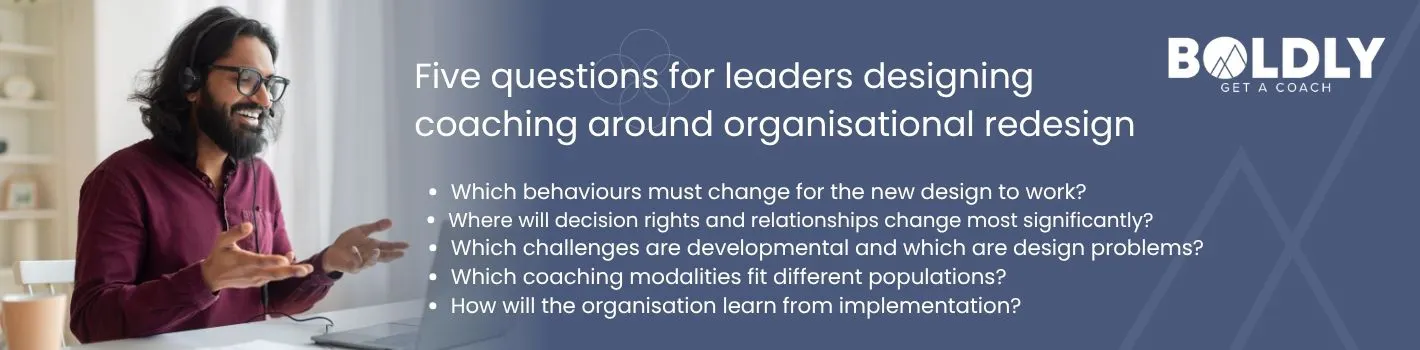
These questions connect leadership development directly to organisational execution.
Frequently asked questions
What is coaching for organisational design?
Coaching for organisational design is the purposeful use of coaching to help leaders and teams operate effectively within a new or evolving organisational structure. It supports behavioural adaptation around areas such as decision rights, accountability, collaboration, delegation and leadership identity while the wider design work addresses structure, processes, systems, rewards and governance.
At what stage of an organisational redesign should coaching begin?
Coaching can begin with senior leaders during design and preparation, particularly where they need to examine how their own behaviour will need to change. Broader coaching typically becomes most relevant as new roles, governance arrangements and ways of working are introduced. Timing should follow the transformation plan and respect situations where information remains confidential.
Can coaching fix unclear roles or decision rights?
Coaching can help leaders navigate ambiguity temporarily and improve how they discuss roles and decisions. Persistent ambiguity requires an organisational solution. Formal accountability, governance and decision rights need to be clarified through design. Coaching is most effective when the underlying system is sufficiently coherent for leaders to operate it.
Is team coaching useful after a restructure?
It can be particularly useful for newly formed or materially reconfigured leadership teams. Members may need to establish trust, clarify interfaces, redefine decision-making and move beyond legacy functional interests. Team coaching creates a structured setting for developing those collective behaviours.
How should coaching impact be measured during organisational redesign?
Measurement should reflect the redesign's objectives. Relevant indicators may include decision speed, escalation patterns, role clarity, leadership behaviour, collaboration, team effectiveness or adoption of new ways of working. Coaching outcomes should be interpreted alongside structural, cultural and operational factors, because organisational performance cannot reasonably be attributed to coaching alone.
BOLDLY: Coaching for Organisational Transformation through organisational design
Organisational design creates the conditions in which people work. Leadership behaviour determines how those conditions are experienced.
BOLDLY supports organisations through an integrated Coaching for Organisational Transformation approach that connects evidence-based human coaching, AI coaching through momentLeader, technology-enabled coaching operations, screened and vetted global coaches, and coaching governance and quality assurance.
Combined with Bendelta's organisational transformation expertise, this enables coaching to be connected to the wider design system: strategy, structure, leadership, culture, processes, capability and governance. The most useful starting question is therefore not simply which leaders should receive coaching.
It is which leadership behaviours must change for the future organisation to work as designed?
Coaching can then be deployed deliberately against that requirement, helping leaders translate organisational architecture into everyday decisions, relationships and ways of working.
About the Author: Maggie Wong
Maggie Wong is a Coach Business Partner at BOLDLY, where she helps bring world-class coaching to organizations around the globe. She supports the onboarding and development of new coaches while connecting clients with exceptional coaching talent tailored to their needs. Maggie works closely with leaders and organizations on initiatives related to top team effectiveness, leadership development, and large-scale coaching programs. Passionate about enabling meaningful growth, she focuses on building strong partnerships that help individuals, teams, and organizations thrive.