
Coaching Female Leaders: Building Leadership Capability Without Treating Women as the Problem
Posted by Maggie Wong
Many organisations have invested for years in developing female leaders, yet representation still narrows as careers progress. In McKinsey and LeanIn.Org's 2025 Women in the Workplace research, women represented 49% of entry-level employees in participating North American organisations but 29% of C-suite leaders. The same study found that women received less sponsorship and manager advocacy than men, and that differences in aspiration to advance disappeared when women and men received comparable career support.
That matters because the leadership-development problem is easily misdiagnosed. If an organisation sees fewer women progressing into senior roles, an intuitive response is to invest in confidence, executive presence, negotiation or resilience. Those capabilities can be useful for any leader. Yet a programme built primarily around changing women risks treating an organisational pattern as an individual deficit.
The stronger question for Chief People Officers, Talent leaders and Organisational Development functions is broader: what development will help female leaders operate successfully in the organisation, and what needs to change in the organisation so their capability can translate into progression, influence and performance?
Coaching has an important role here. Evidence-based coaching can give women space to develop judgement, behavioural range, leadership identity and influence in the context they actually face. At organisational level, Coaching for Organisational Transformation can also help organisations understand where recurring barriers sit in leadership systems, culture, sponsorship, work design and talent processes.
Women's leadership capability is not the underlying constraint
The case for coaching female leaders should begin with a basic point: women do not need coaching because they are inherently less effective leaders. A meta-analysis of 99 independent samples examining leadership effectiveness found no overall gender difference in perceived effectiveness. When ratings from other people were considered separately, women were assessed as more effective than men in several organisational contexts, including middle and senior management.
This finding does not mean gender has become irrelevant to leadership. It points towards a more useful distinction. The issue often lies in how leadership capability is recognised, interpreted and rewarded, not whether that capability exists. Decades of organisational psychology have examined this dynamic. Alice Eagly and Steven Karau's role congruity theory describes how culturally held expectations about leaders can conflict with expectations about women. Leadership has historically been associated strongly with agentic characteristics such as authority, assertiveness and dominance, while women are more often expected to demonstrate communal characteristics such as warmth and support.
The resulting tension is practical. A woman may need to demonstrate authority to meet the expectations of a senior role while also encountering a different response to that behaviour than a male colleague would. The exact experience varies considerably by culture, race, occupation, organisational environment and the individual herself, so organisations should resist reducing women's leadership to a single universal experience. Good coaching helps a leader make sense of the context without teaching her simply to conform to it.
Coaching works best when it strengthens agency without ignoring the system
There is a legitimate concern in women's leadership development: interventions intended to help women succeed can inadvertently imply that women themselves need fixing. A critical examination of coaching for women leaders describes this as a potential "double jeopardy". Development can genuinely increase an individual's agency while simultaneously leaving the organisational conditions creating inequality untouched.
That distinction should influence programme design. A woman preparing for an enterprise leadership role may want to strengthen her political judgement, delegation, strategic influence or ability to manage conflict. Coaching can help. A leader deciding whether to pursue a larger role may want to examine her aspirations, trade-offs and assumptions about readiness. Coaching can help there too.
But if qualified women are routinely excluded from commercially significant assignments, lack senior sponsorship or encounter inconsistent promotion standards, individual coaching cannot correct the underlying talent system. The most mature approach holds both realities simultaneously. Leaders have agency and can develop. Organisations also shape who receives opportunity, visibility, sponsorship and credibility.
The latest McKinsey and LeanIn.Org findings illustrate why that systems perspective matters. Their 2025 research found that women remained underrepresented across the corporate pipeline and received less career support and fewer opportunities to advance. When levels of manager and senior-leader support were comparable, the observed gender gap in desire for promotion disappeared.
For HR and Talent leaders, coaching should therefore sit alongside rigorous promotion processes, equitable access to stretch assignments, sponsorship, succession governance and accountability for leadership decisions.
Leadership identity becomes more complex as women move into senior roles
Promotion into senior leadership changes more than job scope. It can change how a person understands herself as a leader and how others interpret her authority. This is particularly relevant for leaders entering environments where relatively few women have held comparable roles.
A qualitative study of senior women undertaking executive coaching found that leader-identity formation became a central theme in their coaching experiences. Participants described the importance of developing an authentic leadership identity while navigating gendered expectations within senior organisational contexts. The study involved only eleven women in Australia, so its findings should not be generalised universally, but it provides useful insight into the questions that can surface in coaching.
The coaching conversation may concern how a leader wants to exercise authority, what she wants to be known for, where she is modifying herself unnecessarily and where adapting her behaviour genuinely improves effectiveness. These are not superficial questions about "leadership style". They affect decision quality, relationships, influence and the leader's capacity to operate sustainably at greater organisational scale.
Research-based frameworks for developing women leaders similarly emphasise the interaction between the organisational environment, career and life-stage factors, and the development of confidence, influence and authentic leadership presence. Effective coaching therefore avoids prescribing a particular model of female leadership. The objective is to expand behavioural choice and leadership effectiveness while keeping the organisational context visible.
Progression depends on opportunity as well as development
Leadership capability is built through work. Stretch assignments, P&L responsibility, transformation programmes, international roles, difficult stakeholder environments and exposure to senior decision-making all generate experience that cannot be reproduced entirely through formal learning.
This creates an important issue for organisations trying to strengthen their female leadership pipeline. Development investment has limited value if access to career-building work remains uneven. McKinsey's long-running pipeline research identifies the first move into management as a persistent pressure point. In its 2024 North American study, 81 women were promoted into manager roles for every 100 men, creating an early gap that compounds through subsequent leadership levels. The research has since expanded internationally and found different but still systemic advancement constraints across India, Nigeria and Kenya, reminding global employers that the barriers are not identical across markets.
This should influence how coaching programmes are evaluated. If a cohort develops stronger confidence, strategic judgement and stakeholder capability but participants continue receiving fewer consequential assignments, the organisation has developed capability without addressing access.
Coaching can help women prepare for and navigate career opportunities, but Talent functions should examine the complementary organisational questions: Who is nominated for stretch work? Who receives sponsorship? Who is considered ready before they have performed the role? Whose career risks are encouraged and whose are treated cautiously?
Coaching should address real leadership demands, not generic themes
Female leadership programmes sometimes converge around a predictable curriculum: confidence, visibility, networking, resilience and executive presence. Each may be relevant. None should be assumed to be the development need simply because the participant is a woman.
The stronger approach begins with the organisation's leadership context. A newly appointed divisional leader may need support shifting from functional expertise to enterprise thinking. A transformation executive may need to improve decision-making through ambiguity. A senior technical leader may need to exercise greater influence across a matrix. A high-potential manager may need to learn how to develop others rather than solving problems herself.
These are leadership challenges. Gender may influence how the leader experiences them, and a coach should be capable of recognising that dimension without making it the explanation for every difficulty. A systematic review of women's leadership programmes found wide variation in programme design and evaluation and noted continuing uncertainty about the degree to which individual development programmes translate into organisational gender change. This is an important warning for organisational buyers: participant development and organisational transformation are related but distinct outcomes.
Coaching should have clear behavioural objectives, while the wider initiative should address structural outcomes such as progression, retention, succession depth and access to strategic roles.

Human coaching creates depth; group coaching can change what women learn from one another
Different coaching modalities can serve different purposes. Individual executive coaching creates a confidential environment for working with complex career, identity, stakeholder and behavioural issues. It is particularly useful where a leader needs sustained challenge and the coach must understand the evolving context around significant decisions.
Group coaching adds another dimension. Leaders can recognise that experiences they interpreted as entirely personal may also reflect wider organisational patterns, while still taking responsibility for their own behaviour and choices.
A study of a multinational organisation combining individual executive coaching with group coaching for female leaders found distinct value in both forms, including individual development through one-to-one coaching and collective learning through group work. The authors emphasised that this was a case study and called for further research, but their findings illustrate why programmes may benefit from more than one coaching modality.
For organisational transformation, that collective perspective can be valuable. Shared patterns provide information about how leadership is experienced across the organisation. If many participants independently raise difficulties obtaining sponsorship, influencing a particular decision-making group or navigating the same transition point, Talent and OD leaders should consider whether the issue sits partly within the organisational system.
AI coaching can extend reflection into everyday leadership moments
Leadership development does not occur only during scheduled coaching conversations. Behaviour is shaped during ordinary moments: preparing to challenge a senior colleague, deciding whether to volunteer for a stretch assignment, responding to critical feedback, negotiating resources, managing a difficult stakeholder or reflecting after a meeting where one's influence did not land as intended.
AI coaching can increase access to structured reflection around these moments. Through momentLeader, BOLDLY can extend developmental support into the flow of work. A leader can examine her assumptions before an important conversation, consider alternative responses, prepare for a decision or reflect immediately after an event while the detail remains fresh.
Human coaching remains important where relational depth, complex contextual judgement, emotional nuance and sustained challenge are required. AI coaching serves a complementary role by increasing the frequency and accessibility of reflective practice. This creates a broader enterprise coaching ecosystem. Executive coaching, leadership programmes, 360 feedback, group coaching and manager development establish capability and insight; AI coaching can reinforce application between those interventions.
The evidence for executive coaching more broadly supports its relevance to behavioural development. A 2023 meta-analysis of 20 randomised controlled studies found an overall moderate effect and stronger effects on behavioural outcomes than on attitudes or relatively stable personal characteristics, while also reporting meaningful variation between studies. The implication should remain measured: coaching can support behavioural change, but leadership outcomes continue to depend on opportunity, organisational design, culture, incentives and the operating environment.
Coaching data can help organisations distinguish individual issues from systemic ones
Enterprise coaching creates another opportunity when programmes are governed carefully. Individual coaching conversations need confidentiality. Organisations should not receive private details that compromise the trust required for effective coaching.
Aggregated patterns are different. Across a sufficiently large coaching population, de-identified themes may help Talent and OD leaders understand where female leaders are encountering repeated organisational friction. Those patterns might relate to decision authority, workload, sponsorship, role transitions, stakeholder expectations or the experience of organisational change.
This can create an important feedback loop between individual development and organisational transformation. The principle is simple: if one leader encounters a challenge, coaching may help her navigate it. If a large number of capable leaders encounter the same challenge, the organisation should examine the system producing it. This is where technology-enabled coaching operations, governance and analytics become strategically useful. They allow organisations to coordinate coaching at scale while developing a more informed view of leadership capability and recurring developmental demand.
The organisational goal is a stronger leadership system
Deloitte's 2025 global survey of 7,500 women across 15 countries found that women's workplace experiences continue to be influenced by factors ranging from career progression and organisational culture to health and responsibilities outside work. These findings reinforce why a single explanation for women's leadership progression is rarely adequate.
For senior People leaders, coaching female leaders should therefore be designed as part of a leadership system. That system includes selection, sponsorship, succession, work design, manager behaviour, organisational culture, career opportunity, leadership development and accountability. Coaching contributes by strengthening the individual's capacity to operate within that environment while giving the organisation another lens on where the environment itself requires attention.
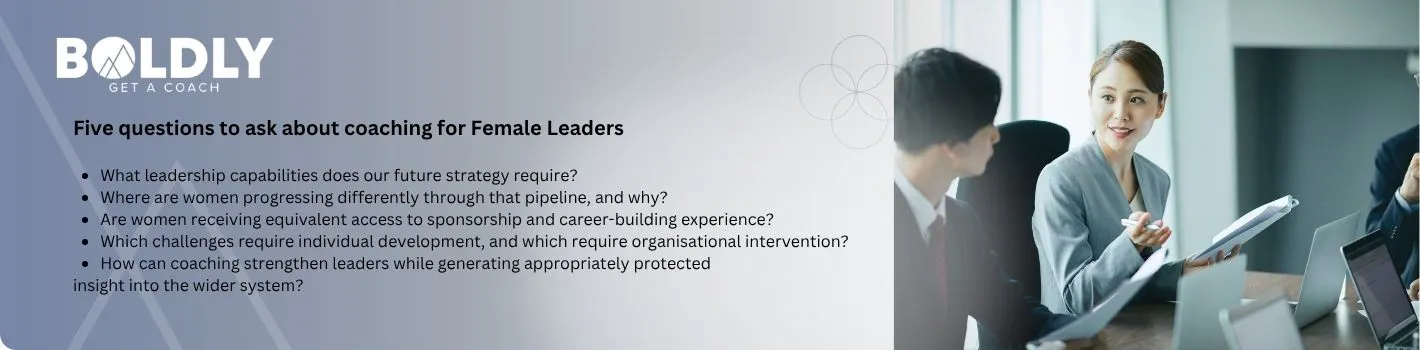
Answering those questions moves women's leadership development closer to organisational capability building.
Frequently asked questions
Why should organisations offer coaching specifically for female leaders?
There can be value in coaching designed with awareness of gender-related career and leadership dynamics, particularly where women are underrepresented in senior roles or encounter identifiable barriers to progression. The purpose should be clear. Coaching should strengthen leadership capability and help individuals navigate their organisational context without implying that women themselves are responsible for structural inequality.
Does coaching improve women's promotion rates?
Coaching can develop behaviours, judgement, confidence and leadership effectiveness, but promotion depends on many additional factors, including opportunity, sponsorship, performance, organisational need and the quality of talent decisions. Organisations should therefore avoid claiming that coaching alone will improve representation. Coaching is most useful when combined with fair progression and succession systems.
Should women have female coaches?
Coach gender can be relevant to some participants but should not be treated as a universal matching rule. Coaching fit depends on factors including experience, credibility, coaching capability, context and the coachee's preferences. Some women may value a coach with direct experience of gender dynamics in leadership; others may prioritise industry or transformation expertise.
How does AI coaching support female leaders?
AI coaching can provide accessible reflection around everyday leadership situations between human coaching sessions or formal development programmes. It can help leaders prepare for conversations, work through decisions and practise behavioural choices. Human coaching remains particularly valuable for complex, relational and highly contextual leadership issues.
How should organisations measure coaching for female leaders?
Measures should connect to programme purpose. Useful indicators may include observable behavioural development, 360 feedback, progression, succession readiness, access to stretch opportunities, retention and leadership effectiveness. Organisational measures should be considered alongside coaching outcomes so that systemic barriers are not mistaken for individual development gaps.
BOLDLY: Coaching female leaders as part of organisational transformation
Developing female leaders is ultimately a question of organisational capability. BOLDLY supports organisations through an integrated Coaching for Organisational Transformation ecosystem combining evidence-based human coaching, AI coaching through momentLeader, executive, leadership, team and group coaching, screened and vetted coaches, global delivery capability, coaching governance and technology-enabled coaching operations.
Together with Bendelta's organisational transformation expertise, this allows coaching to connect individual leadership development with succession, culture, talent systems and the behavioural requirements of organisational change. The objective is not to create a separate model of leadership for women. It is to ensure that capable leaders have the development, opportunity and organisational conditions required to contribute at their highest level — while helping organisations recognise where their own systems are constraining that contribution.
About the Author:
Maggie Wong is a Coach Business Partner at BOLDLY, where she helps bring world-class coaching to organizations around the globe. She supports the onboarding and development of new coaches while connecting clients with exceptional coaching talent tailored to their needs. Maggie works closely with leaders and organizations on initiatives related to top team effectiveness, leadership development, and large-scale coaching programs. Passionate about enabling meaningful growth, she focuses on building strong partnerships that help individuals, teams, and organizations thrive.