
Coaching Is Redefining Workplace Wellbeing — And Strengthening Leadership Performance
Posted by Cara Leverett
Workplace wellbeing has moved from an employee experience initiative to a board-level priority. For HR, Talent and L&D leaders, the challenge is no longer whether wellbeing matters. It is how to design systems that genuinely strengthen leadership capability, sustain performance, and protect organisational health under pressure.
Policies alone do not shift behaviour. Campaigns do not alter deeply held assumptions about workload, success, or psychological safety. What changes outcomes is how leaders think, decide and interact — especially when complexity rises.
This is where coaching is leading the change.
Coaching operates at the level where wellbeing and performance intersect: individual cognition, relational dynamics, and systemic patterns. It enables leaders to build self-awareness, regulate pressure, and create environments where people can contribute sustainably. When designed with rigour, grounded in behavioural science, and delivered at scale through technology-enabled platforms such as BOLDLY, coaching becomes an organisational lever — not an individual perk.
Why Traditional Wellbeing Interventions Often Plateau
Many wellbeing strategies remain programmatic: mental health awareness training, resilience workshops, access to employee assistance services. These components matter. They signal intent and provide support.
Yet they rarely alter the day-to-day leadership behaviours that shape culture.
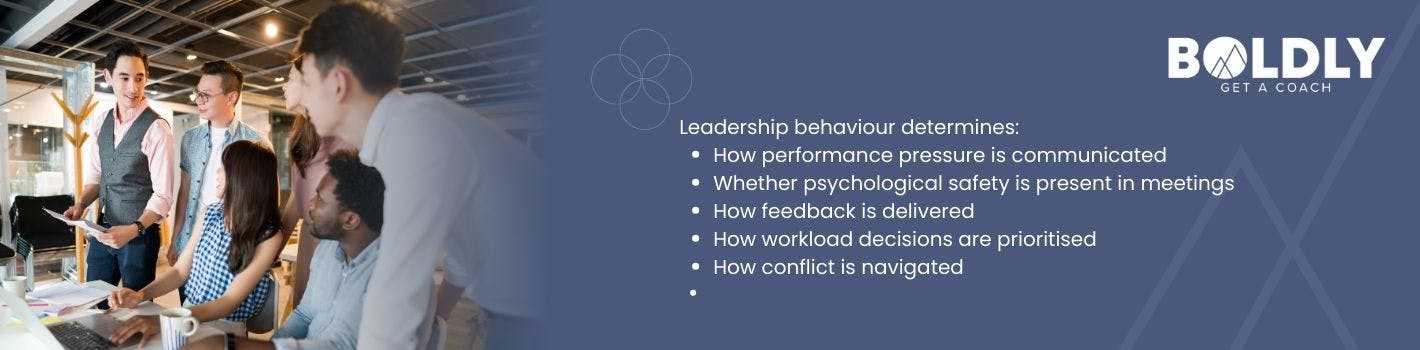
Amy Edmondson’s work on psychological safety demonstrates that team learning and performance depend on environments where individuals feel safe to speak up (Harvard Business School research). Psychological safety is not created through policy. It is created through leadership behaviour.
Coaching addresses this behavioural layer directly. It creates structured reflection, cognitive reframing, and accountability that shifts how leaders interpret and respond to pressure.
Coaching Connects Wellbeing to Organisational Performance
Wellbeing cannot be positioned as separate from performance. High-performing organisations recognise that sustainable performance depends on cognitive capacity, emotional regulation, and clarity of decision-making.
Evidence-based coaching, as articulated by Stober & Grant (2006), integrates behavioural science with practical experimentation to generate measurable change. Cognitive-behavioural coaching, in particular, supports leaders to:
- Identify unhelpful thinking patterns
- Reframe assumptions under stress
- Design behavioural experiments
- Build sustainable performance habits
Research in occupational health psychology consistently links leadership style with employee engagement, burnout risk, and productivity. The Job Demands–Resources model developed by Demerouti and Bakker provides a framework for understanding how leadership behaviours can either buffer or intensify strain (overview here).
Coaching enables leaders to become active designers of these “resources” — clarity, autonomy, feedback quality, role alignment — within their teams.
This is not abstract development. It directly impacts retention, discretionary effort, and organisational resilience.
From Individual Insight to Systemic Shift
A common misconception is that coaching focuses narrowly on the individual. In practice, high-quality executive coaching integrates systemic thinking.
Systemic coaching approaches draw on organisational psychology and complexity theory to surface patterns across teams and structures. Leaders examine:
- How incentives drive behaviour
- How communication flows create bottlenecks
- Where decision rights are unclear
- How power dynamics influence wellbeing
Vertical development theory, including the work of Robert Kegan on adult development, highlights how leaders grow in their capacity to manage complexity and ambiguity. As leaders develop more sophisticated meaning-making structures, they navigate competing priorities with greater composure and perspective.
Coaching provides the relational container for this developmental growth. It supports leaders to step back, examine their assumptions, and expand their cognitive range — a critical capability in volatile operating environments.
The Role of Mentoring and Coaching in Wellbeing Program Design
For HR and Talent leaders designing workplace wellbeing strategies, coaching and mentoring serve different, complementary purposes.
- Mentoring accelerates knowledge transfer and career navigation.
- Coaching strengthens thinking capability, behavioural adaptability, and leadership presence.
When embedded intentionally, coaching:
- Equips managers to lead difficult conversations
- Promotes psychologically safe team environments
- Empowers leaders to manage their own cognitive load
- Advocates for reflective decision-making under pressure
The 70/20/10 framework, widely used in adult learning design, reinforces that development is most sustained when learning occurs in the flow of work. Coaching operationalises this principle. Leaders apply insight directly to live business challenges, generating both performance outcomes and wellbeing gains simultaneously.
Technology Enables Scale — It Does Not Replace Depth
As demand for coaching increases, scalability becomes central to design. Technology-enabled coaching platforms can:
- Match leaders with accredited, vetted coaches
- Provide governance and quality assurance
- Capture anonymised insight data to inform organisational strategy
- Ensure ethical standards aligned with professional bodies such as ICF and EMCC
Technology should strengthen structure, measurement, and accessibility. It should not attempt to replace the relational depth that makes coaching effective.
BOLDLY’s model combines:
- A global marketplace of screened, evidence-based coaches
- Agnostic accreditation standards signalling quality
- Workflow tools that enable large-scale coaching operations
- Integration with broader organisational development capability
This architecture allows organisations to extend coaching beyond the executive layer, embedding it as a systemic lever for workplace wellbeing and leadership performance.
Coaching as a Preventative Burnout Strategy
Burnout prevention requires more than reactive intervention. It requires leaders who can:
- Recognise early signs of cognitive overload
- Design team rhythms that enable recovery
- Challenge unproductive performance norms
- Create clarity in ambiguity
Coaching strengthens metacognition — the ability to think about one’s own thinking. This capacity is foundational to emotional regulation and adaptive leadership.
Neuroscience research on stress and cognitive load demonstrates that chronic activation narrows attentional bandwidth and impairs executive functioning. Leaders who develop reflective capability are better positioned to interrupt this cycle and model sustainable behaviour.
Coaching therefore functions as a preventative strategy. It strengthens leaders’ internal resources before crisis emerges.
Practical Implications for HR and Talent Leaders
If coaching is to lead the change in workplace wellbeing, design decisions matter.
Consider:
- Targeting critical leadership nodes
Focus on managers and senior leaders whose behaviour shapes team climate. - Integrating coaching into performance cycles
Align coaching objectives with business priorities, not as parallel initiatives. - Embedding evaluation frameworks
Measure impact across engagement, retention, leadership effectiveness, and performance metrics. - Maintaining quality and ethical standards
Ensure coaches are accredited, supervised, and grounded in evidence-based practice. - Leveraging anonymised insight data
Use aggregated coaching themes to inform organisational strategy while protecting confidentiality.
Workplace wellbeing improves when leadership capability evolves. Coaching provides the structured, relational mechanism to enable that evolution.
Coaching Is Not Purely a Wellbeing Initiative. It Is a Leadership Strategy.
For commercially minded organisations, the distinction is significant.
Wellbeing framed as benefit can be deprioritised in cost-constrained environments. Leadership capability linked to performance, retention, and strategic execution remains central.
Coaching connects the two. It equips leaders to sustain performance while safeguarding human capacity.
For HR and Talent leaders seeking measurable, systemic impact, coaching represents a mature, evidence-based pathway forward.
If you are reviewing how coaching and mentoring integrate into your workplace wellbeing strategy, BOLDLY partners with organisations globally to design scalable, high-quality coaching solutions grounded in behavioural science and organisational performance.
Get in touch to explore how coaching can enable sustainable performance across your leadership population.
FAQs: Coaching and Workplace Wellbeing
How does coaching improve workplace wellbeing?
Coaching strengthens leadership behaviour under pressure — improving clarity, psychological safety, workload prioritisation and decision-making. Wellbeing improves when leaders think and act differently in the flow of work.
Is coaching separate from performance strategy?
No. Coaching connects wellbeing directly to performance by building cognitive agility, emotional regulation and accountability. Sustainable performance depends on these capabilities.
Can coaching scale across an organisation?
Yes, when supported by robust technology, governance and accredited coaches. Scale should enhance quality and insight, while preserving the depth of the coaching relationship.
How is coaching impact measured?
Impact is assessed through clear objective setting and alignment to business metrics such as engagement, retention, leadership effectiveness and performance outcomes.
Where does mentoring fit?
Mentoring accelerates knowledge transfer and career development. Coaching strengthens thinking capability and behavioural adaptability. Together, they create a comprehensive capability strategy.

AUTHOR: Cara Leverett
Cara works across strategy, social media and consulting, supporting organisations to build visibility and meaningful engagement in the coaching, leadership development and adult learning space .She is particularly interested in how coaching-led learning and HR technology can be combined to create meaningful behaviour change and scalable impact for leaders and teams. Her work sits at the intersection of strategy, creativity and innovation, with a focus on translating complex ideas into clear, engaging narratives.
Drawing on a foundation in communications and creative problem-solving, Cara brings an innovative and considered perspective to her work across HR technology and digital learning platforms. She is curious about how organisations use digital tools, insight-led content and coaching experiences to support growth, performance and culture. Cara enjoys shaping ideas that resonate with senior HR, OD, L&D and talent leaders, and turning strategic thinking into content that connects and drives action.