
How Organisations Scale Coaching Across the Business
Posted by Cara Leverett
Leadership development has entered a period of structural change. Organisations are under pressure to develop leadership capability faster, across more levels, and with greater relevance to real work. Executive coaching has long been recognised as one of the most effective mechanisms for leadership development. What has changed is the expectation that coaching should extend beyond a small group of senior leaders and become part of how organisations develop capability more broadly.
Scaling coaching across a business requires more than increasing the number of sessions delivered. It involves building the conditions in which coaching becomes a credible, evidence-based mechanism for leadership and career development across the organisation.
Senior HR and organisational development leaders are increasingly asking a deeper question: how does coaching move from a high-impact intervention for individuals to a leadership development capability embedded across the enterprise?
The answer lies in three interconnected areas: coaching architecture, coach quality, and technology-enabled delivery.
Coaching as Infrastructure for Leadership Development
Leadership development has historically been organised around programs. Coaching operates differently. It works through reflection, behavioural experimentation, and contextual problem-solving over time. These characteristics allow coaching to support the complexity leaders face in modern organisations.
Research across organisational psychology consistently links coaching to improvements in leadership capability, goal attainment, and wellbeing (Theeboom, Beersma, & van Vianen, 2014). Meta-analytic evidence also shows measurable effects on performance and work attitudes when coaching is delivered by trained professionals (Jones, Woods, & Guillaume, 2016).
These findings have contributed to a growing recognition that coaching is not only a development intervention; it can function as leadership development infrastructure.
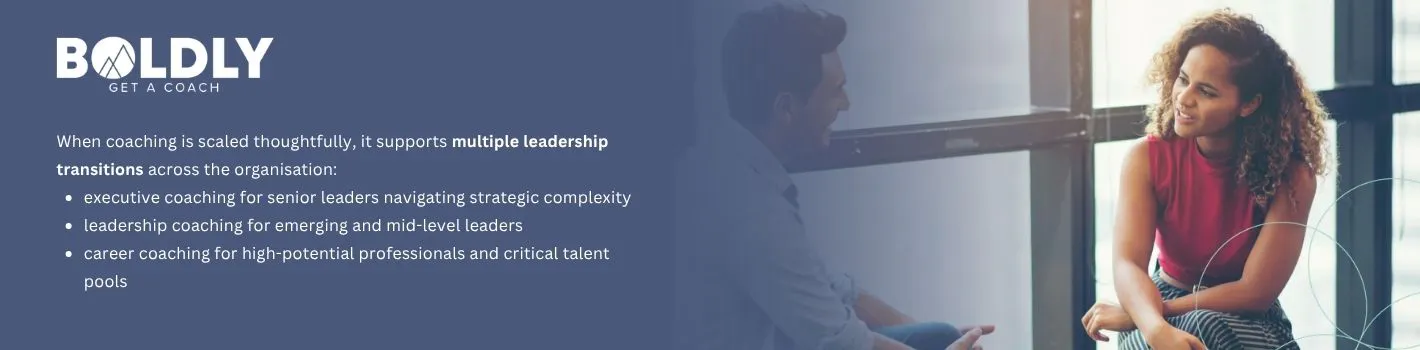
Each level addresses different developmental questions, yet all operate through a similar mechanism: structured reflection that connects insight to action within real organisational contexts.
Evidence-based coaching models grounded in behavioural science, cognitive approaches, and adult development theory provide the foundation for this work (Grant & Cavanagh, 2006; Stober & Grant, 2006).
Designing Coaching Architecture Across the Organisation
Scaling coaching begins with architecture rather than volume. Organisations that achieve meaningful scale define how coaching connects to their leadership and talent strategy.
Three design principles commonly emerge.
Alignment with leadership moments
Coaching gains traction when it supports moments that already carry developmental weight. Leadership transitions, expanded scope, cross-functional responsibility, and strategic project leadership all create conditions where reflection and behavioural experimentation generate tangible outcomes.
Embedding coaching into these moments allows leaders to apply insights immediately within their work context.
Multiple coaching modalities
Large organisations rarely rely on a single coaching format. Executive coaching remains critical for senior leaders managing complex organisational systems. Group and team coaching can accelerate shared learning and strengthen collaboration across leadership cohorts. Career coaching supports individual growth, mobility, and retention within talent pipelines.
When these modalities are connected, coaching begins to operate as a system rather than a set of isolated engagements.
Integration with talent strategy
Coaching becomes scalable when it aligns with leadership frameworks, talent reviews, succession planning, and development pathways. This integration enables HR leaders to deploy coaching where it supports organisational priorities rather than distributing it evenly or reactively.
Coach Quality and Evidence-Based Practice
As organisations expand access to coaching, coach quality becomes increasingly important.
Professional coaching bodies such as the International Coaching Federation (ICF) and the European Mentoring and Coaching Council (EMCC) emphasise the role of accreditation, supervision, and ethical practice in maintaining professional standards.
Evidence-based coaching integrates psychological theory, practitioner expertise, and client context (Grant & Cavanagh, 2006). This combination supports leaders in examining assumptions, experimenting with new behaviours, and reflecting on outcomes over time.
Several psychological approaches frequently underpin leadership and executive coaching:
- cognitive-behavioural coaching, which supports leaders to examine thinking patterns and behavioural responses
- systemic coaching, which explores patterns within organisational systems
- adult development approaches that support shifts in meaning-making and perspective
- action learning cycles that connect reflection to practical experimentation
Professional coaches draw on these approaches to tailor conversations to each leader’s developmental context. This flexibility is central to coaching effectiveness.
Technology as an Enabler of Coaching at Scale
Technology has introduced a structural shift in how organisations deliver coaching.
Digital platforms allow organisations to match leaders with qualified coaches across geographies, schedule sessions efficiently, and manage coaching operations across thousands of employees. These platforms also enable programme oversight, measurement, and integration with broader learning ecosystems.
Importantly, technology extends access without replacing the human relationship at the centre of coaching.
Research into coaching effectiveness consistently highlights the importance of the coaching relationship and psychological safety (De Haan, Duckworth, Birch, & Jones, 2013). Technology can support logistics, scale, and programme visibility, while the developmental work continues to occur within the conversation between coach and client.
Organisations that scale coaching effectively treat technology as infrastructure that supports quality rather than substituting for it.
Measuring Impact Across Leadership and Career Development
Senior HR leaders increasingly expect leadership development investments to demonstrate measurable outcomes.
Coaching programmes can be evaluated through several complementary lenses:
- leadership capability development
- goal attainment and behavioural change
- engagement and retention among critical talent groups
- leadership pipeline readiness
- organisational performance indicators connected to leadership behaviour
Evaluation approaches often combine quantitative and qualitative data. Structured assessments, stakeholder feedback, and reflective progress reviews provide insight into how leaders apply learning in their roles.
Over time, this evidence base helps organisations refine where coaching creates the greatest organisational value.

The Strategic Role of Coaching in Modern Organisations
Scaling coaching reflects a broader shift in how organisations approach leadership development.
Leadership capability increasingly develops through cycles of experience, reflection, and behavioural experimentation. Coaching creates the space for these cycles to occur intentionally.
For HR and organisational development leaders, the strategic question is less about whether coaching works and more about how coaching can operate as a development capability that supports leaders across the enterprise.
When supported by evidence-based practice, high-quality coaches, and technology-enabled delivery, coaching can move from a specialised intervention to a central component of leadership and career development.

Frequently Asked Questions
What does it mean to scale coaching across an organisation?
Scaling coaching involves extending access to coaching beyond a small group of senior leaders and embedding it across leadership development, talent programmes, and career pathways. It often includes executive coaching, leadership coaching, group coaching, and career coaching delivered across different organisational levels.
How does executive coaching differ from career coaching?
Executive coaching typically focuses on senior leaders navigating strategic, organisational, and stakeholder complexity. Career coaching often supports professionals earlier in their leadership journey as they clarify goals, develop capability, and navigate career progression within the organisation.
Does coaching actually improve leadership performance?
Multiple meta-analyses have demonstrated that professional coaching can positively influence leadership capability, goal attainment, wellbeing, and work attitudes (Jones et al., 2016; Theeboom et al., 2014).
How do organisations measure the ROI of coaching?
Organisations evaluate coaching using a combination of indicators including leadership capability development, behavioural change, engagement levels, leadership pipeline readiness, and performance outcomes linked to leadership effectiveness.
Can coaching be delivered effectively at scale?
Yes. Technology platforms enable organisations to manage large coaching ecosystems by connecting leaders with qualified coaches globally, managing logistics, and tracking programme impact. Human coaching conversations remain central to the developmental process.
What role does technology play in scalable coaching?
Technology enables matching, scheduling, programme oversight, and analytics across large coaching programmes. Its role is operational and enabling. The developmental impact continues to come from the coaching relationship and structured reflection.

AUTHOR: Cara Leverett
Cara works across strategy, social media and consulting, supporting organisations to build visibility and meaningful engagement in the coaching, leadership development and adult learning space .She is particularly interested in how coaching-led learning and HR technology can be combined to create meaningful behaviour change and scalable impact for leaders and teams. Her work sits at the intersection of strategy, creativity and innovation, with a focus on translating complex ideas into clear, engaging narratives.
Drawing on a foundation in communications and creative problem-solving, Cara brings an innovative and considered perspective to her work across HR technology and digital learning platforms. She is curious about how organisations use digital tools, insight-led content and coaching experiences to support growth, performance and culture. Cara enjoys shaping ideas that resonate with senior HR, OD, L&D and talent leaders, and turning strategic thinking into content that connects and drives action.